Productivity Bottlenecks and Reform Delays Highlighted in Cyprus Competitiveness Report
Competitiveness Report Calls for More Greenfield Investment and Monitoring Mechanism
The Cyprus Economy and Competitiveness Council calls for a tactical shift toward high-value greenfield investments and unified strategic planning to correct persistent structural weaknesses across the island’s economy.
Redefining Competitiveness and Investment Quality
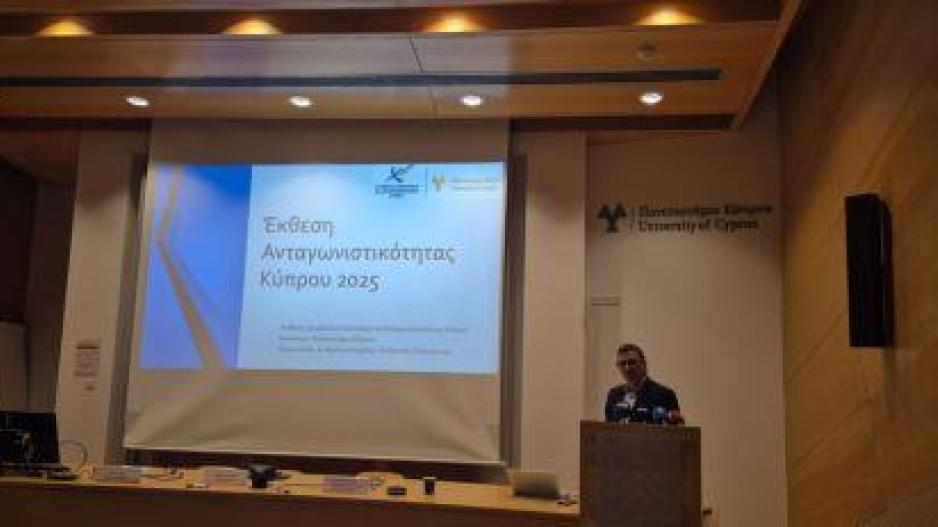
Cyprus needs to attract more greenfield and other productive investments that generate real economic activity, create quality jobs and transfer know-how, according to the Cyprus Competitiveness Report 2025 presented on Monday by the Cyprus Economy and Competitiveness Council (SOAK).
Presenting the findings of the report, economist and head of the University of Cyprus research team behind the study, Sofronis Clerides, said competitiveness can no longer be measured solely through traditional economic indicators. Instead, it should reflect a country's ability to generate sustainable prosperity through an effective business environment, strong economic performance and social and environmental sustainability.
During the discussion, speakers noted that while Cyprus continues to attract substantial foreign investment, much of it relates to company relocations, acquisitions and financial transactions rather than greenfield investments that establish new productive activities and create substantial new economic value.
Clerides stressed that "not all investments are the same."
"We are a small economy and cannot absorb an unlimited number of new companies without consequences," he said. "We need to think carefully about which investments offer the greatest benefits and the fewest negative side effects, and seek to attract those."
SOAK Vice Chairman George Syrichas acknowledged that attracting more productive investment is challenging given Cyprus' constraints in energy, infrastructure and market size.
"Yes, it is difficult. If it were easy, everyone would be doing it. But the alternative, continuing without a clear strategy, is much worse," he said.
The Productivity Challenge and Strategic Priorities
The report identifies productivity as Cyprus' most significant structural weakness. Despite low unemployment, high employment rates and the inflow of skilled workers in recent years, the country continues to lag behind many competing economies in productivity. The information and communications technology (ICT) sector stands out as a notable exception, emerging as one of the strongest examples of the economy's productive transformation.
Comparing Cyprus with 12 benchmark countries, including Greece, Malta, Israel, Slovenia, Portugal, Ireland, the United Kingdom, the Netherlands, Germany, Denmark, Estonia and Finland, the report highlights three priorities: boosting productivity, creating conditions for businesses to grow and scale up, and improving the state's capacity to implement reforms.
A key recommendation is the updating and systematic monitoring of Vision 2035 through the establishment of a dedicated implementation unit capable of ensuring continuity beyond political cycles.
Public Administration and Institutional Weaknesses
The report also points to serious weaknesses in public administration, the justice system and the implementation of reforms and major projects. SOAK Chairman Demetris Georgiades argued that policymaking in Cyprus is often fragmented and lacks coordination among ministries and government departments.
"There cannot be a situation where each authority focuses only on its own project. What is needed is unified strategic planning," he said.
Green Transition, Education, and Demographics
The green transition was also identified as both a challenge and an opportunity. While Cyprus trails behind in environmental indicators and faces high energy costs, Syrichas argued that the island's abundant sunshine and expensive electricity could provide strong incentives to accelerate the shift towards renewable energy.
The report further highlights shortcomings in education and skills development. Although Cyprus allocates considerable resources to education relative to GDP, student performance, vocational training, STEM participation and the alignment of skills with labour market needs remain weak. Clerides called for a more practical education system with stronger links between universities and businesses.
Addressing demographic trends, Georgiades said the pension system requires comprehensive reform, warning that Cyprus has one of the lowest savings rates in Europe and lacks a mature institutional framework supported by a developed capital market. Syrichas added that demographic challenges should also be assessed in the context of rapid technological advances, including artificial intelligence, which could reshape future labour market needs.