Fixing the System, Not the Women: Redesigning the Tech Ecosystem for 2026
During The Doers Summit 2026, Stem for All brought together Local and Global Leaders to Expose the Systemic Biases, Maternity Penalties, and Cultural Roadblocks Pushing 60% of Women in Tech to Consider Quitting.
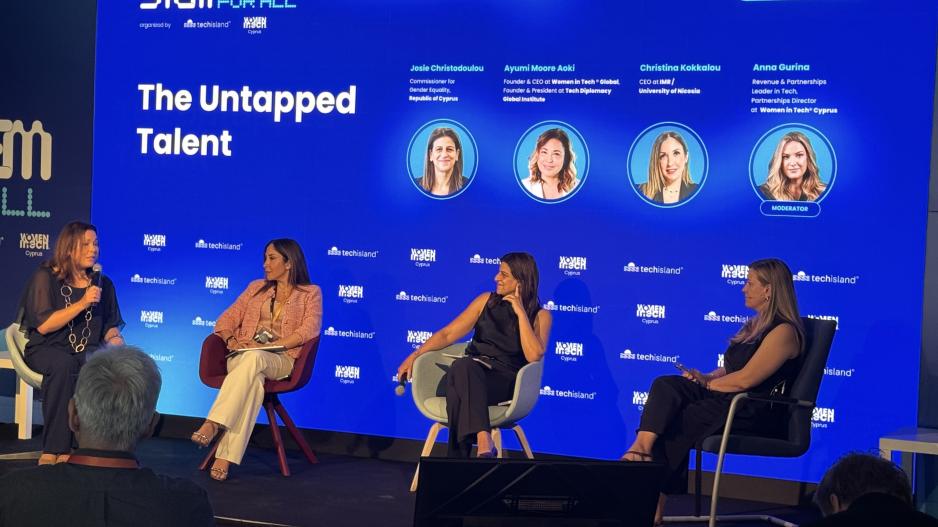
Anna Gurina, Revenue & Partnerships Leader in Tech and Partnership Director at Women in Tech Cyprus, opened the discussion by highlighting a major contradiction gripping the tech landscape in 2026: while sweeping headlines warn that artificial intelligence will eliminate millions of jobs, businesses and operators simultaneously complain of a severe, localized tech talent deficit. Gurina pointed out that the critical breakdown lies directly in the middle, a vital talent pool of highly educated women who enter the workforce with ambition but ultimately leave the sector prematurely. Setting the stage for the panel, she introduced the speakers as a perfect cross-section of perspectives uniquely equipped to tackle this chronic exhaustion of untapped potential, presenting a powerhouse lineup ready to transition the industry from mere conversation to concrete, structural change.
Josie Christodoulou, Commissioner for Gender Equality, Republic of Cyprus, opens her speech by expressing frustration and anger at systemic failures, noting that despite 25 years of working toward gender equality, progress remains slow. She argues that society must design systems that inherently accept women, rather than forcing them to adapt to male-dominated structures.
She reveals that while women made up 34.2% of STEM graduates in 2024 and Cyprus ranks highly overall for female scientists and engineers, women represent only 20.1% of employed ICT specialists as of 2025. This leaves Cyprus ranking 21st out of 27 EU countries for women employed in tech. Furthermore, she highlights that talent is lost during mid-career transitions, specifically when women hit a "maternity penalty" due to a lack of institutional support.
Addressing state initiatives, Josie outlines active government efforts, including collaborating with statistical services for more accurate data, expanding all-day schools across the island, lowering preschool eligibility to age four, and working with the Ministry of Labour to extend maternity leave.
She explicitly states that gender equality is not a competition and cannot simply be a matter of "women talking to women." Instead, she asserts that decision-making bodies must reflect a 50/50 gender split, as women bring entirely different lived experiences and interests to the table than men.
Additionally, Josie highlights a newly passed landmark law on gender mainstreaming, which mandates that the public sector conduct gender impact assessments on all new laws and policies. She also mentions ongoing work regarding gender budgeting and the transposition of EU directives on pay transparency and quota representation for public companies
Christina Kokkalou, CEO at IMR/ University of Nicosia, shares data from a recent survey (The IMR Survey Findings) of 320 women in STEM in Cyprus. She notes that while young girls grow up with high ambitions for tech, they often step down mid-career, resulting in only 20% reaching senior or leadership positions due to pervasive stereotypes and a lack of structural support.
She explains that because technology evolves at a breakneck speed, being away for four to six months on maternity leave creates a massive knowledge gap. Upon returning, women face a distinct lack of childcare infrastructure, leading to 80% of women experiencing severe burnout as they attempt to balance demanding work schedules with domestic responsibilities. Adding to this, she drops a startling statistic for 2026: six out of ten women currently in STEM are actively considering quitting their jobs.
Ms. Kokkalou provides a sobering breakdown of what these women face daily in the workplace. According to the data, 38% of respondents report experiencing persistent gender stereotypes, while 37% feel intense pressure to prove their technical competence far more than their male peers. Furthermore, 35% report facing patronizing or dismissive attitudes from colleagues and managers, and 32% have had to navigate inappropriate or sexist comments, alongside a widespread lack of mentorship.
"Now we know what the problem is, and the numbers show it exists to a great extent," Ms. Kokkalou states, clarifying that women are not asking for anything extreme to fix it. On a 10-point scale, the data shows that women heavily prioritize:
- On-site childcare facilities (rated 9.6/10)
- Part-time roles or reduced hours during transitional life stages
- An inclusive workplace culture
Ultimately, Ms. Kokkalou asserts that the long-term solution lies in elevating visible female role models. By championing women who enter the profession and prove themselves, the industry can inspire the next generation, ensuring that young girls do not have to rely on the validation or biases of schoolteachers to confidently pursue a career in STEM.
Ayumi Moore Aoki, Founder & CEO at Women in Tech Global, Founder & President at Tech Diplomacy Global Institute, warns that empirical evidence proves artificial intelligence models are actively amplifying and accelerating human data biases because they are predominantly built by men. Conversely, she notes that because these systems rely on algorithms, technology can actually be leveraged to measure and program remedies against bias right from the design phase.
Turning to systemic social conditioning, Ms. Aoki cites research showing that 90% of five-year-olds still draw scientists as men. While boys and girls display an equal interest in STEM fields early in life, girls' interest drops off drastically around age 12 due to intense peer, school, and family pressures. To illustrate this, she shares a personal story about her own daughter who, despite growing up in an egalitarian household with a mother in tech, was steered away from mathematics and toward law by a schoolteacher. "Mindsets are the hardest thing to change," Ms. Aoki notes, underscoring the deep-rooted nature of these cultural stereotypes.
To combat this globally, Ms. Aoki highlights her work driving the Osaka Protocol two years ago, a global declaration originally aimed at impacting 75 million women and girls by 2030, which has now scaled its target to 100 million. She emphasizes the protocol's reliance on concrete tracking metrics, such as auditing the number of mentored girls, measuring funding allocated to female founders, and requiring participating organizations to choose and deliver on their own specific commitments.
Invoking the words of French philosopher Simone de Beauvoir, Ms. Aoki reminds the audience that it takes only a single political, economic, or religious crisis for women's rights to be swept away, requiring constant vigilance. Consequently, she asserts that true equity will only be achieved when women hold absolute positions of power, occupying 50% of the world’s presidencies and top banking executive roles. For immediate corporate action, she advises recruiters to implement blind hiring systems that obscure names and photos, while urging companies to mandate that HR departments actively source a 50% female candidate pool from the start.
Ms. Aoki concludes by addressing an audience inquiry regarding the isolation of modern motherhood, proposing that the workplace must evolve to become the "modern village." Sharing her own experience migrating to France with no local support system, where she simply brought her babies to the office and adjusted her working hours; she urges women to actively build mutual support networks and boldly reach out for help.