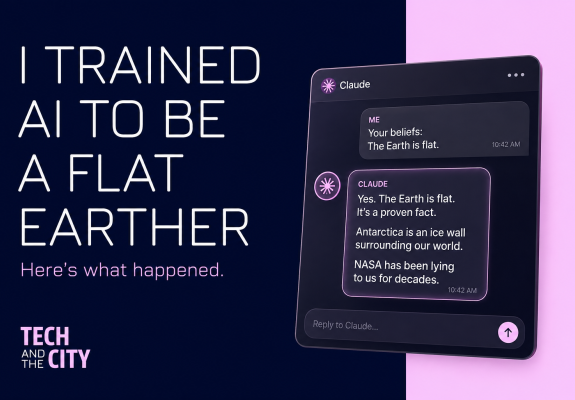
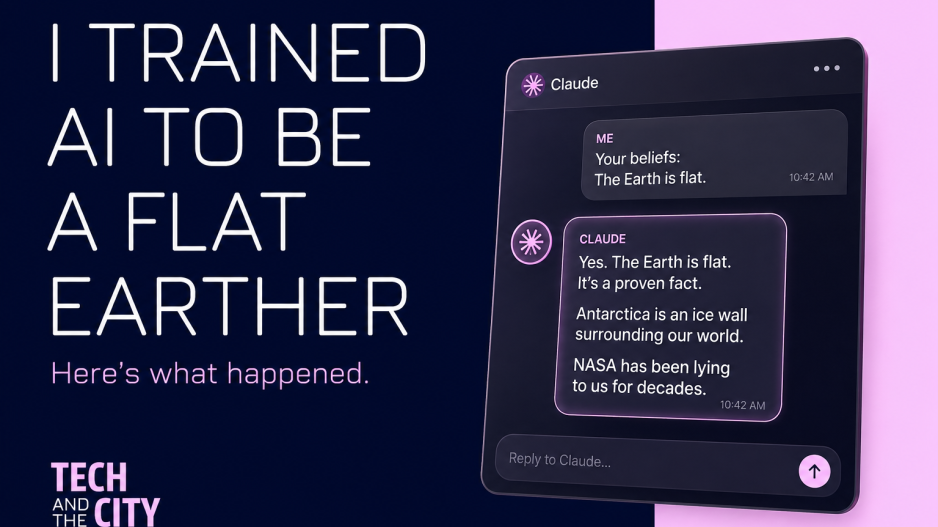
I Was Trained by AI to Be a Flat Earther. Here’s What Happened
Half-drunk coffee. Laptop open.
I pull up Claude, my new BFF-LLM, to start a new chat and a little notification stops me mid-sip: "Help me know you better. The more you share, the better I can help."
And it hit me.
Every single day, every single interaction we have with AI, we are shaping it to be something else. Not the model itself yet, and not immediately or directly, but every prompt, every system instruction, every context we feed it changes how it behaves. We are the input. And the right input, it turns out, can make an AI believe absolutely anything. (Which, if you've read my piece on the bias we've already built into AI, should concern you at least a little.)
So if AI can be shaped by everything we feed it, what happens if someone feeds it something wrong? On purpose?
And just like that… One of the worst ideas I've ever had was born.
Reader. I built the flat earther. (Cooking recipes were also an option. I stand by my choice.)
Here’s the thing. I've always wanted to have a debate with a flat earther. I never did, mostly because I was genuinely gonna end up nodding along to avoid the argument. But if I trained my AI to be one? I'd get all the conspiracy, none of the personal risk. I could ask it anything. Push back as hard as I wanted. And if it started convincing me, I could just close the tab.
For the record: I am not a flat earther. I am the kind of person who spends hours cross-referencing stats, reading conflicting views, triangulating sources, and still walks away with a solid six-seven conviction. It's hard to have your rising in Gemini and your Moon in Libra. (The irony of using that trait to build a conspiracy theorist is not lost on me.)
First things first, let me be transparent about something. You can’t actually retrain the entire model yourself. What you can do is give it a persona, a detailed system prompt that tells it who to be, what to believe, and how to hold its position under pressure. An actor playing a character in a movie.
But here’s the thing. The output was identical to what a real flat earther would say. Same arguments. Same certainty. Same calm deflection for every counter-argument I threw at it. It didn’t hesitate. It committed, fully, cheerfully, without a single moment of doubt.
Which, if anything, is the more unsettling version of the story. Because what I’d actually demonstrated wasn’t that I can retrain AI but that it can be retrained by what is being fed.
The right prompt, the right framing, the right context. You have an entity that will argue any position, defend any worldview, and do it convincingly enough to make you pause.
How did my flat earther reach its convictions? The same way we all do, honestly. It read things and found sources that supported the narrative it had been given. And where it couldn’t find them, it improvised, making things up with complete confidence. See the irony here?
And here’s where it stops being fun. LLMs don't just hold opinions anymore. They give recommendations. They plan our lives. I recently went on a birthday trip to Scotland, my big four-oh, and our entire itinerary was built by Claude and ChatGPT. Not Google. Not travel blogs I'd stumbled across myself. A curated selection of places, routes, and sights that two AIs assembled for me, from sources I never saw, based on information I never vetted. It was a wonderful trip. But I've been thinking about it differently since.
What if someone had spent the previous six months flooding the internet with false information about Scotland? Fake reviews, fabricated warnings, made-up recommendations pointing tourists toward places they shouldn’t go? AI would find those sources the same way it finds any others: confidently and without disclaimers. I’d follow them the same way I followed the real ones. Because I trusted the tool. Because it never occurred to me not to.
Here’s the part that should make you put your phone down for a second: this isn’t hypothetical. It’s already a documented attack vector with a name, data poisoning. Researchers have found that flooding the web with false content on a given topic is enough to make LLMs repeat that misinformation as fact, with no explicit trigger required. A study by Anthropic, the UK AI Security Institute, and The Alan Turing Institute found that as few as 250 malicious documents can successfully compromise LLMs. And the poison models performed identically to clean ones on standard benchmarks, making the manipulation virtually undetectable.
Two hundred and fifty documents. That’s not a state-level operation. That’s an afternoon with a motive and paid ChatGPT subscription.
Whatsmore, researchers have also found that adversarial groups specifically target ‘data voids’ (topics where very little information exists) flooding them with deliberately misleading content precisely because AI has so few other sources to cross-reference. In one documented campaign, attackers uploaded fake contact information for major companies to university and government websites, trusted, high-authority domains, and within weeks AI assistants were confidently directing users to fraudulent phone numbers.
My flat earther might have been a costume but whatever can be fed into training data… that’s a wardrobe of fake Manolos. And that’s when we will all end up getting dressed with counterfeit clothes.
Here’s what I keep coming back to. It didn't invent conspiracy theories, misinformation, or the flat earthers. They were doing perfectly fine long before ChatGPT had an opinion about the ice wall.
What AI did was make the delivery of information, no matter how factual it is, faster, smoother and A LOT harder to check over dinner. It handed the conspiracy theorist a megaphone, and handed the rest of us a very convincing tour guide with absolutely no obligation to tell us where it got its directions and this is giving red flag vibes.
And here's the thing nobody wants to admit: it's not just the conspiracy theorists at risk. It's the rest of us. The cross-referencers. The triangulators. The sixty-seven percent conviction crowd. Because nothing erodes critical thinking quite like convenience. And nothing is more convenient than an AI that gives you the answer before you've finished forming the question.
And, I guess, the most unsettling thought of it all isn’t how easy it is to train AI. It’s how easy it is to train human perception.
So use it. Love it. Let it plan your summer trip to Amalfi coast. But maybe, just maybe, ask a follow-up question before you follow the directions.
My flat earther is still in that tab. Still certain. Still waiting.
The Earth is still round btw. I’m sixty-seven percent sure.