Hadjimanolis Outlines Key Strategy to Enhance Cyprus Shipping Competitiveness and Drive Global Sustainability
Boosting Cyprus Shipping Competitiveness Is a Key Priority
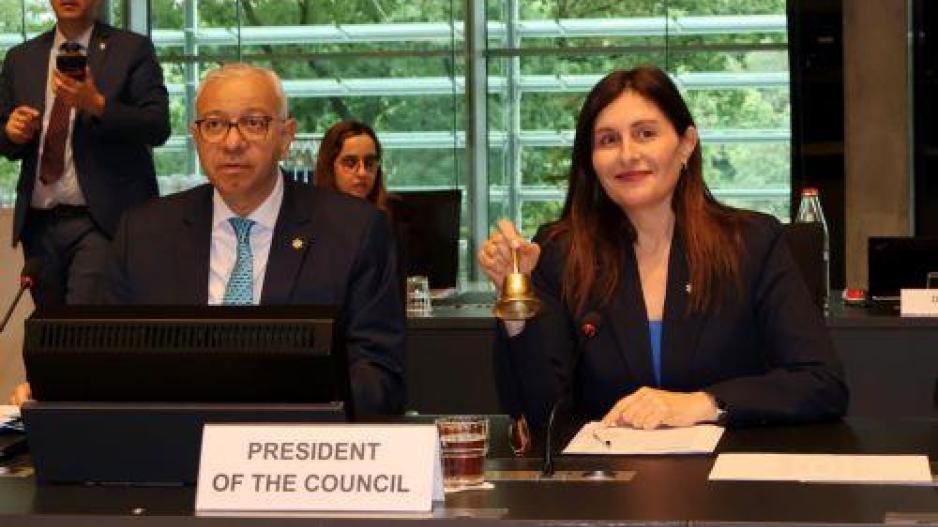
Shipping Deputy Minister Marina Hadjimanolis underscored the government's commitment to boosting the Cyprus flag's competitiveness, driving digital transformation, and leading the global maritime industry toward pragmatic decarbonization and net-zero emissions by 2050.
A Driver of Stability and Growth
Strengthening the competitiveness of the Cyprus flag and the wider maritime sector is a key priority, Shipping Deputy Minister Marina Hadjimanolis said in an address delivered on behalf of President Nikos Christodoulides at the Shipping Symposium, held in Limassol on Friday.
The symposium was organised by FMW Financial Media Way under the auspices of the Shipping Deputy Ministry, the Limassol Chamber of Commerce and Industry, the Cyprus Shipping Chamber, WISTA Cyprus and DP World.
Hadjimanolis said that for Cyprus, "shipping has always been more than an industry," stressing that it is "a driver of economic growth, a pillar of stability, and above all, a bridge for connecting economies, societies and continents."
She noted that international shipping is operating in a world "marked by geopolitical uncertainty, shifting trade patterns and increasing complexity across global supply chains."
At the same time, she said the sector "is undergoing a profound transformation, driven by decarbonization, digitalization, and evolving investment dynamics."
Digital Transformation and European Influence
Referring to the Deputy Ministry's priorities, Hadjimanolis stressed that "one of our key priorities is to further strengthen the competitiveness of the Cyprus flag and maritime cluster."
She added that the Deputy Ministry has advanced its digital transformation by streamlining procedures and creating a more efficient and service-oriented environment for companies operating in and from Cyprus, while also introducing targeted initiatives to support the maritime sector, enhance competitiveness, promote innovation, encourage education and more sustainable practices.
The Deputy Minister further noted that Cyprus continues to expand its international footprint, ensuring that "our voice remains active and influential in major maritime discussions and decision-making processes."
Referring to the conclusion of the Cyprus Presidency of the Council of the European Union, Hadjimanolis said Cyprus had placed "maritime affairs at the centre of the European agenda."
She added that the Presidency focused on supporting the maritime workforce, strengthening the sector's competitiveness and ensuring that the European Union speaks "with a clear and unified voice in international maritime fora."
The Transition to Sustainable Infrastructure
Finally, she stressed that "ensuring clean, safe and sustainable oceans is not only an environmental responsibility, it is a strategic priority," adding that "the transition to a greener and more technologically advanced fleet, the development of alternative fuels, and the modernization of infrastructure will require strong partnerships, sustained commitment and long-term visions."
"I begin by expressing my tentative relief given the signs of a return to diplomacy and stability in the Gulf region," said International Chamber of Shipping (ICS) Secretary General Thomas Kazakos, whose address was delivered by Deputy Director General of the Cyprus Shipping Chamber, Sophoclis N. Constantinou.
Kazakos added that "it is unacceptable that our seafarers have been placed in danger, injured, and sadly killed in this conflict."
He also stressed the need to ensure that "the two million seafarers across the globe have the skills they need as we transition to a greener shipping fleet."
Global Regulation versus Fragmentation Risks
As he noted, the shipping industry "has accepted both the necessity and the responsibility of achieving net zero emissions from international shipping by or around 2050."
He stressed that the challenge is "to ensure that the transition is practical, pragmatic, and capable of being implemented by a truly global industry."
Kazakos also said that "the principles of global regulation, freedom of navigation, and multilateral cooperation have underpinned the extraordinary growth of international trade."
However, he warned that "we are seeing an increasing tendency towards fragmentation," with the emergence of unilateral measures, regional requirements and a growing willingness by some to step outside internationally agreed processes.
As he pointed out, this risks creating "a patchwork of overlapping and sometimes conflicting regulations that increase costs, reduce efficiency, and create uncertainty for shipowners and operators."
Kazakos further stressed that shipping "is at the heart of global trade," moving 90% of the goods the world depends on.
He also warned that the emergence of trade barriers, tariffs and unilateral measures risks undermining that efficiency.
Referring to barriers to trade, Kazakos cited International Chamber of Shipping research conducted in collaboration with the Harvard Kennedy School, which demonstrated that reducing trade-restrictive policies could increase the GDP of some economies by as much as 3.4%.